
 En
En  English
 简体中文
简体中文
What Is a Rubber Belt? Types, Construction, and Selection Guide for Industry
A packaging line stops. A machine starts to squeal. A camshaft drifts out of phase by a few degrees. In many industrial plants, the common denominator is a rubber belt that was selected, tensioned, or maintained incorrectly. A rubber belt is not a generic spare part. It is an engineered component that has to transfer torque, speed, and motion under heat, dust, oil, and varying loads.
This guide explains what a rubber belt is, how it works, what it is made of, which types are available, and how to avoid the failures that cause downtime. We are a rubber belt manufacturer with more than three decades of production experience, so the information here is based on factory process control and field performance, not just textbook definitions.
What Is a Rubber Belt?
A rubber belt is a flexible loop made from rubber compounds and reinforcing materials. It either transmits mechanical power between rotating shafts or moves material from one point to another. In power transmission systems, the belt wraps around pulleys and uses either friction or mechanical teeth to carry torque from the driving pulley to the driven pulley.
Rubber belts generally fall into two families: conveyor belts and transmission belts. A conveyor belt carries bulk materials or products. A transmission belt transfers power, speed, and rotational position between shafts. This article focuses on transmission belts, which are the main products used in automotive engines, machine tools, compressors, packaging equipment, agricultural machinery, and many other industrial drives.
Engineers choose rubber transmission belts because they reduce vibration, tolerate slight shaft misalignment, run quietly, and do not need oil lubrication. They also provide a degree of overload protection: under sudden shock, a belt may slip or fail before a more expensive gearbox or bearing is damaged.
How a Rubber Belt Transmits Power
A rubber belt transmits power in two basic ways: friction grip and positive engagement.
Friction drive belts rely on tension to press the belt into a pulley groove. The contact force between the belt and pulley surface creates friction. When the driving pulley rotates, friction pulls the belt forward, and the belt rotates the driven pulley. V-belts and multi-ribbed belts use this principle. Their wedge-shaped or ribbed profiles increase the contact area inside a matching pulley groove, which improves grip and reduces the tension required.
Positive drive belts, commonly called timing belts or synchronous belts, use teeth on the inner surface. These teeth lock into matching grooves on the pulley. This mechanically prevents slip and keeps two shafts in exact angular synchronization. Timing belts are the reason a camshaft and crankshaft remain aligned in modern engines.
| Drive principle | Friction grip | Mechanical tooth lock |
| Slippage | Possible under shock load or low tension | No slip in normal operation |
| Timing accuracy | Not guaranteed | Maintains exact shaft phase |
| Noise level | Generally quiet when correctly tensioned | Low to moderate depending on tooth profile |
| Typical maintenance | Tension checks required | Less frequent tension adjustment |
| Best application | General industrial drives | Precision motion and engine timing |
Anatomy of a Rubber Belt
A high-quality rubber belt is a composite structure, not a single material. Each layer has a specific job, and the quality of the bond between layers determines how long the belt survives in service.
Rubber compound
Provides friction, flexibility, oil resistance, heat resistance, and wear life. The compound recipe must be matched to the operating environment.
Tension cord
Usually made of polyester, aramid, or fiberglass. The cord carries the tensile load and controls the belt’s ability to resist stretching.
Cover fabric or tooth backing
Protects the belt from wear, dirt, oil, and shear stress. On timing belts, the fabric wrap on the teeth is critical for long life.
During manufacturing, the rubber, cord, and fabric must be vulcanized under controlled time, temperature, and pressure. If vulcanization is inconsistent, the belt may look perfect but have weak internal adhesion. That is why raw material grade and process control matter more than the final visual appearance.
Main Types of Rubber Belts
Industrial rubber belts are designed for different speed ranges, load levels, pulley sizes, and installation geometries. The most common transmission belt types are:
V-Belts
V-belts have a trapezoidal cross-section that rides in a matching pulley groove. The wedge action creates high friction with less tension than a flat belt, making V-belts a first choice for moderate-power industrial drives. Raw-edge cut V-belts are more wear-resistant and run cooler than wrapped V-belts in applications with continuous load.
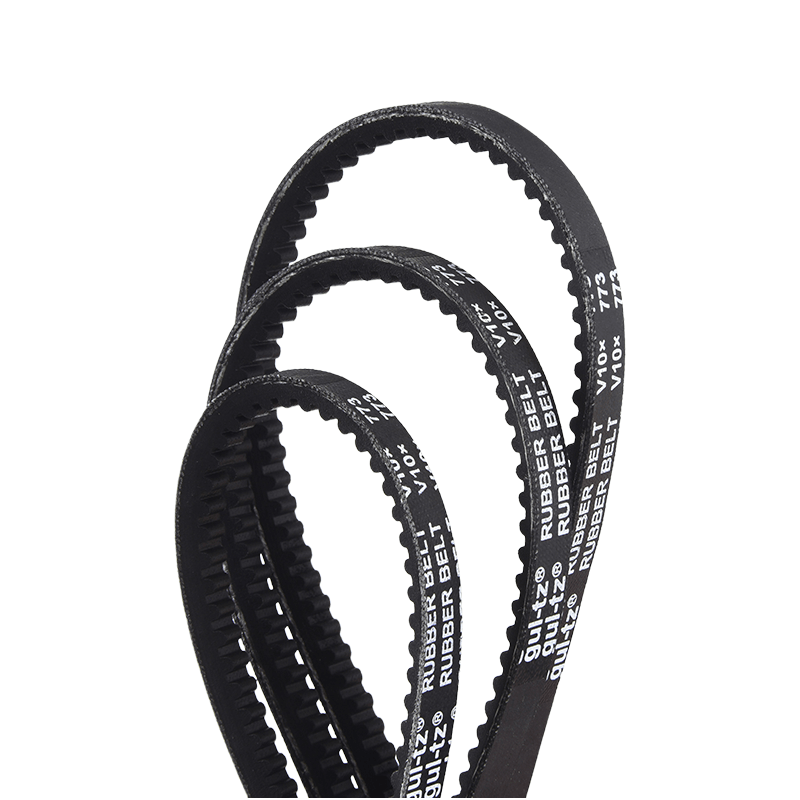 Industrial V-Belt for Power TransmissionThis industrial V-belt suits moderate-power drives where wedge action provides high friction with less tension. Its raw-edge construction improves wear resistance and cooler running under continuous load.View Product →
Multi-Ribbed Belts
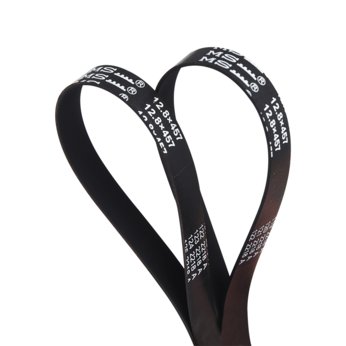
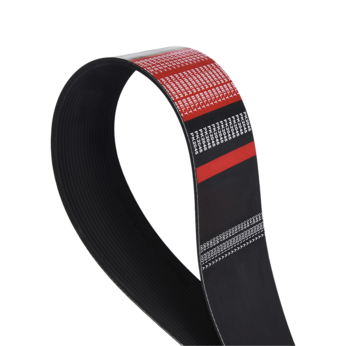
Multi-ribbed belts, also called ribbed belts or poly-V belts, combine the flexibility of a flat belt with the grip of a V-belt. Several longitudinal ribs run along the inside surface. This distributes load across a wider area, which allows compact pulleys, higher speeds, and smoother operation than a single V-belt on the same center distance.
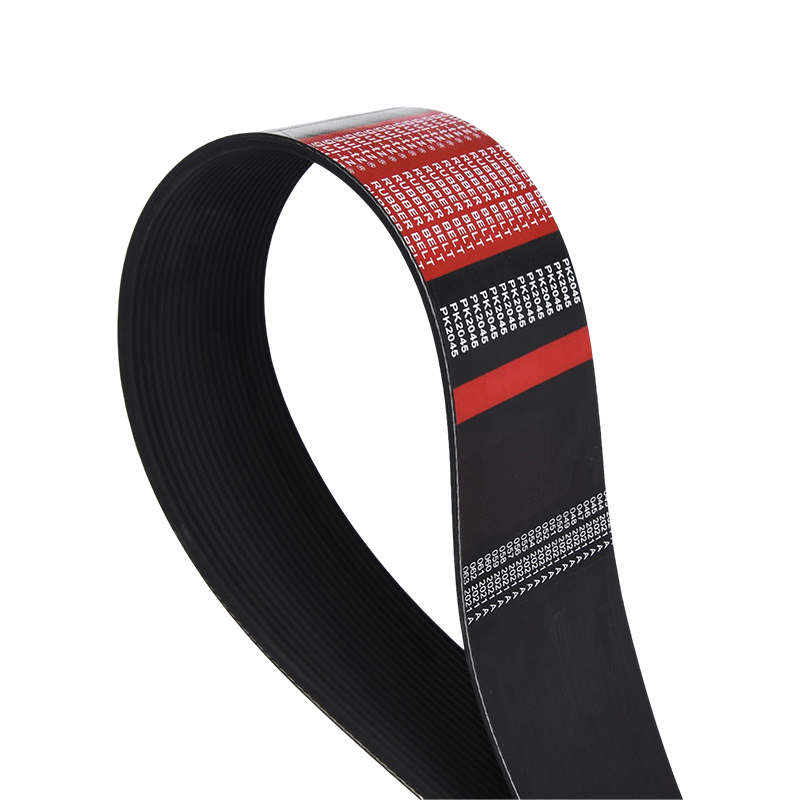 Multi-Ribbed Poly-V Belt for Compact DrivesThis V-ribbed belt combines V-belt grip with flat-belt flexibility, enabling compact multi-axis layouts and small pulleys. It offers higher power capacity, reduced space, and good heat and oil resistance.View Product →
Timing or Synchronous Belts
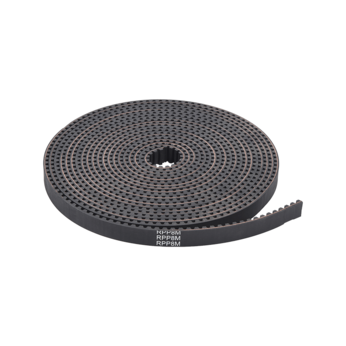
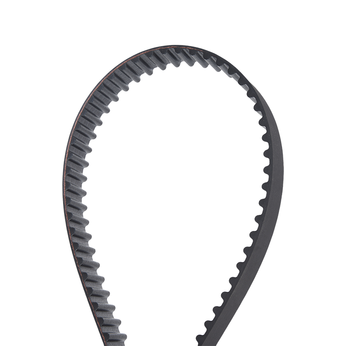
Timing belts have teeth on the inner side and run on grooved pulleys. Because there is no slip, they provide exact speed ratio and shaft position. Timing belts are standard in automotive engines, print machinery, robotics, and any application where precise synchronization is essential. Curved tooth profiles such as arc-tooth designs lower stress on the belt and improve meshing stability under load.
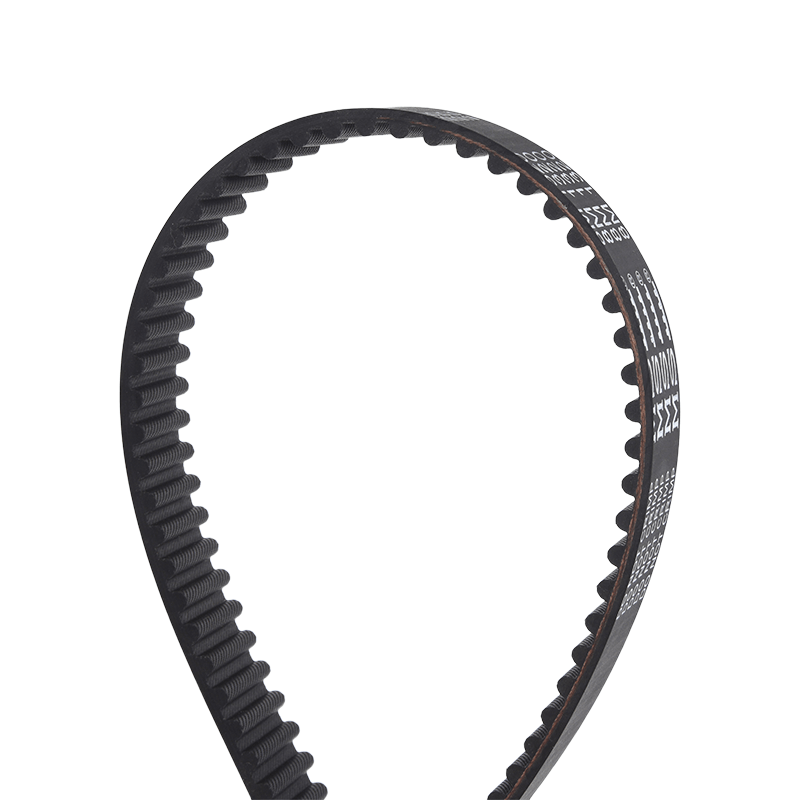 Arc-Tooth Industrial Timing BeltThis arc-tooth timing belt ensures slip-free synchronization for precise speed ratio and shaft position. Its curved tooth profile lowers stress and improves meshing stability, ideal for high-load industrial drives.View Product →
Flat Belts
Flat belts have a simple rectangular cross-section and run on cylindrical pulleys. They are efficient for high-speed, low-tension applications with large pulleys and smooth surfaces. Flat belts are still used in many material handling and light industrial drives because of their quiet operation.
How to Choose the Right Rubber Belt
Belt selection should start with application duty, not price. In our experience, most premature belt failures come from selecting a type that is close to the requirement but not matched to the actual load, environment, and pulley geometry.
Rubber belt selection checklist
- Power and speed: define the power to transmit and the speed ratio between the two shafts.
- Shock loads: frequent start-stop cycles or jamming loads require a stronger section and reinforced cord.
- Center distance: the distance between shaft centers determines the required belt length and whether a tensioner is needed.
- Pulley diameter: small pulleys force the belt into tighter bending and can shorten service life.
- Environment: oil, moisture, heat, ozone, and abrasive dust all change the required rubber compound.
- Tensioning method: fixed centers, spring-loaded tensioners, and manual adjustment affect how often the belt needs inspection.
The chart below provides a rough comparison of relative load capacity among common rubber belt types. Actual performance depends on width, section size, compound, and cord strength.
Flat beltModerate
V-beltHigh
Multi-ribbed beltHigh
Synchronous beltVery high
Do not choose a belt section only by shaft center distance or belt length. The cross-section and tooth profile must be matched to the dynamic torque, allowable deflection, and pulley contact arc.
Why Manufacturing Quality Matters
A rubber belt can look identical before and after a good or bad production run, yet service life can differ by more than fifty percent. The difference usually lies in cord tensioning, tooth profile accuracy, and the vulcanization cycle.
We are a manufacturer, not just a trading company. Our factory in Ningbo covers 32,000 square meters and produces more than 120 million rubber belts per year. We have participated in drafting national and industry standards for rubber transmission belts, and we maintain ISO 9001, ISO 14001, and ISO 45001 certified management systems. These standards affect the way we control materials, cure rubber, and measure finished dimensions.
For precision drives, dimensional control is especially important. A synchronous belt must maintain an accurate pitch across every tooth. Even a small variation in cord pitch creates concentrated stress and leads to early tooth cracking. The same logic applies to V-belt section angle and rib spacing on a multi-ribbed belt.
Common Rubber Belt Problems and How to Prevent Them
Most rubber belt failures follow recognizable patterns. In troubleshooting, the most useful evidence is where the wear occurs and what the worn surface looks like.
| Symptom | Most common cause | Preventive measure |
| Squealing | Insufficient tension or oily pulley surface | Re-tension the drive and clean pulleys |
| Premature tooth wear | Misalignment or damaged pulley groove | Check alignment and pulley condition |
| Belt jumps teeth | Shock load or tension too low | Increase tension or select a stronger section |
| Cracked back or side | Heat, ozone, or pulley diameter too small | Use heat-resistant compound or larger pulley |
| Excessive stretch | Weak cord construction or overload | Choose reinforced belt or reduce actual load |
| Rapid side-wall wear | Pulley misalignment or wrong groove angle | Realign pulleys and verify groove dimensions |
Not every rubber belt failure is caused by the belt itself. Worn pulleys, shaft misalignment, and contamination are equally common sources of trouble. Keep records of belt run hours and failure patterns so the root cause can be identified instead of repeated.
Rubber Belt FAQ
What is the difference between a rubber belt and a timing belt?
A rubber belt is a broad category. A timing belt is a specific type of rubber belt with teeth that engage grooved pulleys, preventing slip and maintaining synchronization between shafts.
How long does a rubber belt last?
Service life depends on load, speed, environment, and installation quality. An industrial V-belt can run several thousand hours in normal conditions. An automotive timing belt is usually replaced according to the vehicle maker’s recommended interval, often around every 60,000 to 100,000 kilometers or miles.
Can a rubber belt handle oil and heat?
Yes, if the correct polymer is used. Special compounds such as chloroprene rubber and HNBR can resist oil and higher temperatures. A standard rubber belt exposed to oil or heat will degrade more quickly, so material selection should match the environment.
Why does my rubber belt squeal?
Squealing is usually caused by low tension, worn pulleys, or oil on the belt surface. Check these items first before replacing the belt.
Should I replace the belt and pulley at the same time?
For worn or heavily used pulleys, yes. A new belt on a damaged pulley can fail quickly. At minimum, inspect the pulley for wear, rust, burrs, and dimensional damage during every belt replacement.
Final Thoughts
A rubber belt is a simple-looking component, but its performance depends on compound, cord, tooth design, and manufacturing consistency. Choosing the right belt type and keeping tension and alignment correct will reduce downtime and extend the life of the drive system.
If you are evaluating a rubber belt for an industrial drive, start with the operating conditions and ask the manufacturer about compound and cord construction. More details about our factory and certifications are available on our about page. If you cannot decide from the data sheet, contact our engineering team with the drive specifications so we can help you narrow the selection to a belt that will run reliably under your actual load and environment.
Hot Products
-
 View More
-
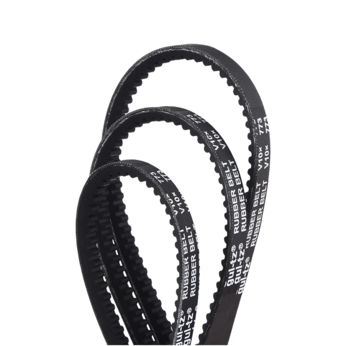 View More
V-belt For Industry
-
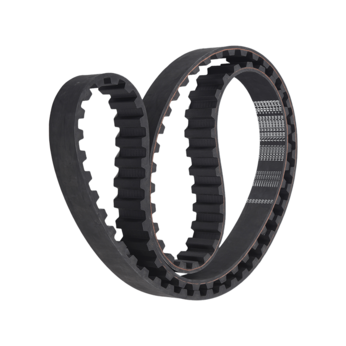 View More
T Type Industry Rubber Synchronous Belt
-
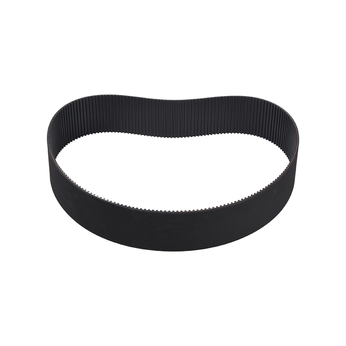 View More
Toothed wedge belt
-
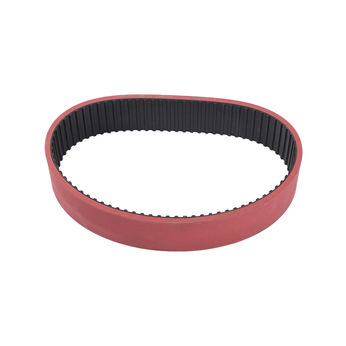 View More
Thickened timing belt
-
 View More
Open Timing Belt
-
 View More
Automotive V-belt
-
 View More
Rubber Flat Belt
-
 View More
Ribbed Belt
-
 View More
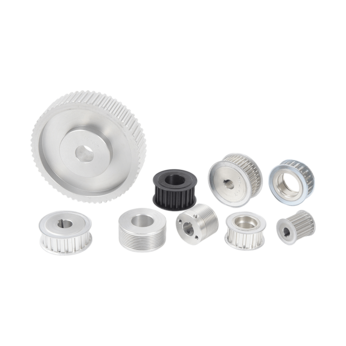
Synchronous Pulley
-
 View More
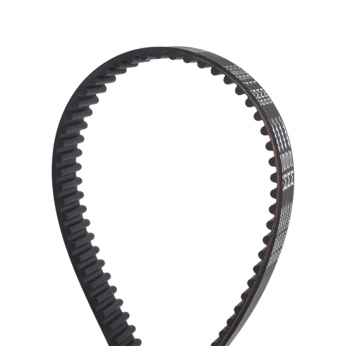
Arc tooth industrial rubber synchronous belt
-
View More
Automotive timing belt

Do you have a question? Feel free to contact!
 Tel: +86-0574-62498188 62497298
 Fax: +86-0574-62497297
 E-mail:
  Add: No. 65, Middle Jinniu Road, Moushan Town, Yuyao City, Zhejiang Province, China
Copyright © Ningbo GUL TZ Rubber Belt Co., Ltd. All rights reserved.

OEM Rubber Driving belts Manufacturers
