
 En
En  English
 简体中文
简体中文
Different Types of Rubber Belts: An Engineer's Guide to Power Transmission
Your drive has just stopped and the rubber belt is torn. When you ask for a replacement, the supplier asks whether you need a timing belt, a V-belt, a ribbed belt, or a flat belt. These four names are not interchangeable. Rubber belts used in power transmission belong to exactly four families: synchronous timing belts, V-belts, ribbed belts, and flat belts. Each family transfers torque with a different mechanical principle, which determines its speed range, load capacity, positioning accuracy, and service life.
For a maintenance engineer, this classification tells you which belt to order before you remove the old one. For a machine designer, it sets the boundary conditions for the whole drive layout. Once the belt family is correct, the next decisions are profile, width, length, and rubber compound. This guide walks through each family, its construction variants, material options, and how to make a practical selection.
The Four Families of Rubber Belts
Every power transmission rubber belt can be grouped into one of four families based on cross-section and how it engages with the pulley. The cards below provide a quick reference, and the table gives a more detailed technical comparison.
Synchronous Belts
Teeth mesh with pulley grooves. No slip, exact angular positioning, high efficiency.
V-Belts
Trapezoidal section wedges into a V-groove. High friction, good shock absorption.
Ribbed Belts
Several small ribs on a flat back. Compact, quiet, suitable for serpentine routing.
Flat Belts
Simple rectangular section with a large contact area. Ideal for very high speed and long centre distances.
| Belt Family | Working Principle | Slip | Speed Range | Typical Applications |
|---|---|---|---|---|
| Synchronous (timing) | Tooth meshing | None | Low to very high | CNC machines, printers, engine camshafts |
| V-belt | Wedge friction | Small | Low to medium | Pumps, compressors, fans, generators |
| Ribbed (multi-V) | Multiple wedge friction | Small | Medium to high | Automotive accessories, appliances, automation |
| Flat belt | Surface friction | Small | Very high | Textile machinery, spindles, long-centre drives |
Synchronous Rubber Belts (Timing Belts)
A synchronous rubber belt, commonly called a timing belt, uses teeth on its inner surface that mesh with matching grooves on the pulley. Engagement is positive, so the belt cannot slip, and the driven shaft stays in exact angular synchronisation with the drive shaft. This makes synchronous belts the standard choice for camshaft drives, printing cylinders, packaging machines, CNC positioning axes, and any system where timing or positional accuracy is critical. They are typically reinforced with glass fibre or aramid cords to keep the pitch stable under load.
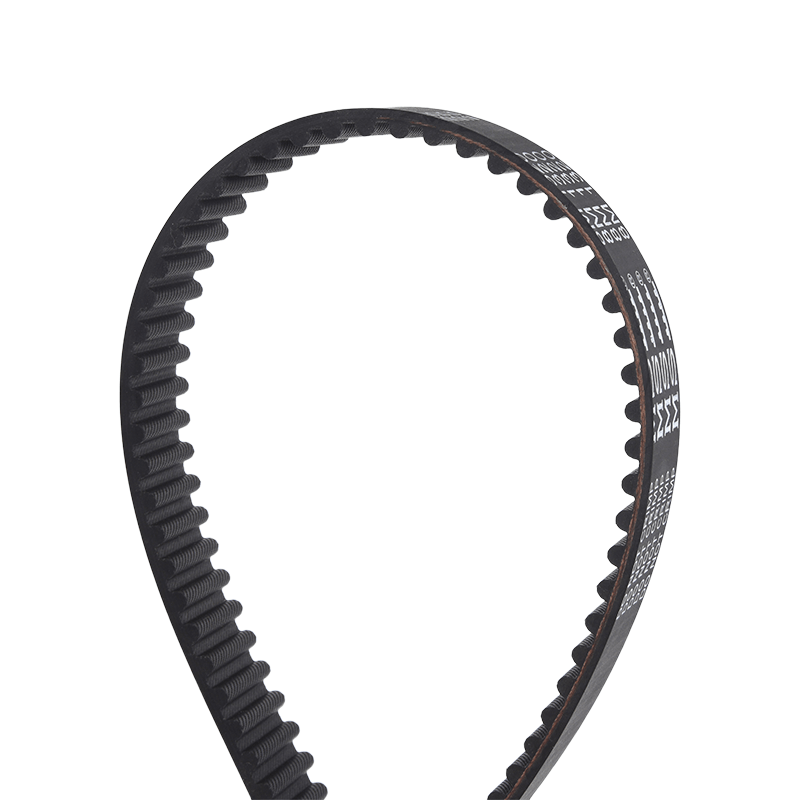 Arc Tooth Industrial Rubber Synchronous BeltThis arc-tooth timing belt offers positive engagement for precise synchronisation. It suits applications requiring accurate positioning and stable pitch, making it a reliable option for camshaft, packaging, and CNC drives.View Product →
T-Type Trapezoidal-Tooth Belts
T-type belts, with pitch designations such as T5, T10, and T20, have straight-sided teeth and a simple trapezoidal form. They are economical, widely stocked, and adequate for moderate-load drives where first cost matters more than low noise or peak torque. Many general-purpose conveyor indexers and woodworking machines run perfectly well on T-type belts.
Arc-Tooth Belts
Arc-tooth belts use a curvilinear tooth profile. Well-known pitch names include HTD, STD, and RPP. The curved flank reduces stress concentration at the tooth root, spreads load over a larger contact area, and allows higher torque transmission from a given belt width. The same geometry engages and disengages more gradually, lowering noise, vibration, and backlash. For high precision and demanding duty, arc-tooth profiles are almost always the better technical choice.
Double-Sided Belts
Double-sided synchronous belts carry teeth on both faces. They are used when one belt must drive components from both the top and bottom side, for example in reversing drives, shuttle mechanisms, or complex routing with idler pulleys on the outside. The tooth form on both sides must literally match the respective pulley-pitch requirements.
Open-Ended Belts
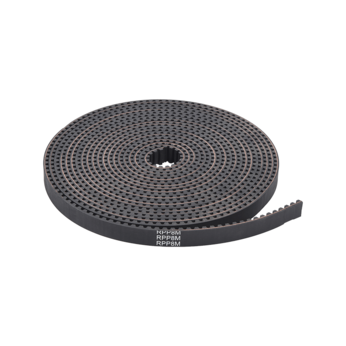
Open-ended timing belts are supplied as a long strip without a joint. Buyers cut them to a defined length in linear positioning units, slide tables, and pick-and-place systems. Because the tensile cords run continuously along the strip, open-ended belts provide strong and consistent push-and-pull behaviour for linear actuators.
Thickened Belts
Thickened or heavy-duty timing belts have additional rubber bulk or extra reinforcement layers. They are engineered for shock loads, repeated torque peaks, and applications where a standard belt would crack at the tooth root prematurely. Shredders, brick presses, and heavy woodworking equipment commonly use thickened timing belts.
Profile pitch, belt width, and belt length all depend on the drive design, so it is important to compare selection criteria before ordering. See our detailed guide on how to choose a synchronous belt for dimensioning steps and common mistakes.
V-Belts
A V-belt has a trapezoidal cross-section that wedges into a matching V-groove on the pulley. The wedge action generates considerably more friction than a flat belt on the same pulley diameter, so a single V-belt can transmit high torque from a compact drive. V-belts are tolerant to misalignment, damp vibration, and protect the driven machine from shock loading. This makes them common on pumps, compressors, fans, and conveyor drive stations.
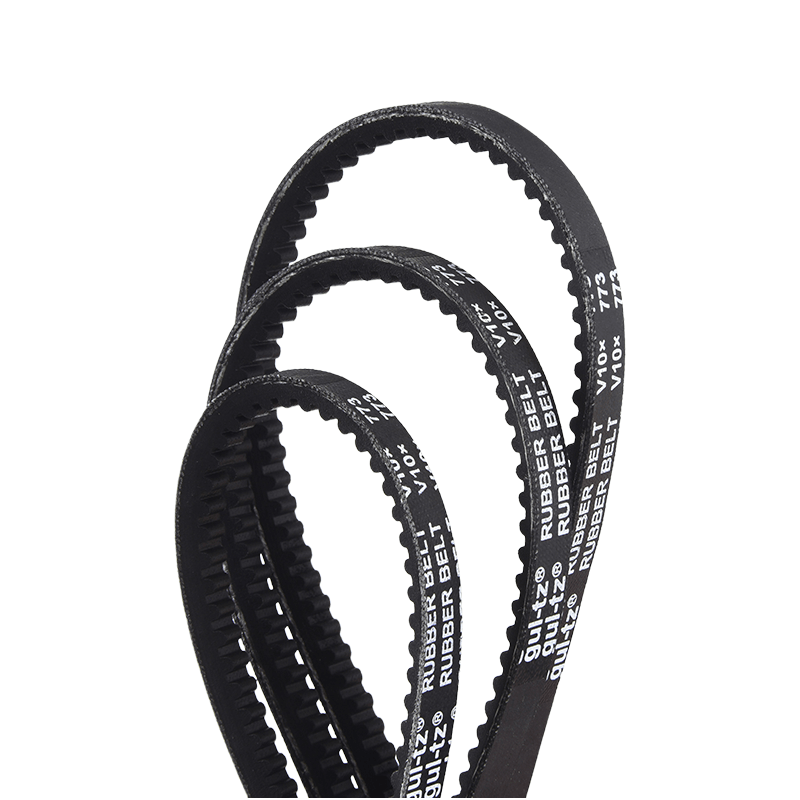 Industrial Wrapped V-BeltThis wrapped V-belt provides dependable power transmission for pumps, compressors, and conveyors. Its fabric cover protects the tensile layer while the wedge action delivers high torque in a compact drive.View Product →
Wrapped V-Belts
Wrapped V-belts have a fabric cover around the whole body that protects the tensile layer and gives a clean, uniform appearance. They bend well and are a safe, low-maintenance choice for general industrial drives. Classical sections such as A, B, C, and D, and narrow wedge sections such as SPZ, SPA, SPB, and SPC all belong to this group.
Raw-Edge and Cogged V-Belts
Raw-edge V-belts have no fabric cover on the side walls, so the rubber compound contacts the sheave directly. This improves traction, reduces heat generation, and typically extends service life under continuous heavy load. Cogged raw-edge versions have notches on the underside that allow the belt to flex around small-diameter pulleys with less internal heat. Replacing a standard wrapped belt with a raw-edge cogged belt on the same drive often gives a noticeable increase in service life, mainly because the belt runs cooler.
Narrow Wedge V-Belts
Narrow wedge belts transfer the same power as conventional V-belts with less width and weight. They also operate at higher speeds and with smaller pulleys, which makes them attractive for new machine designs where space is limited and energy efficiency is a priority.
Ribbed Belts (Multi-V Belts)
A ribbed belt, also called a multi-V or poly-V belt, has several small longitudinal ribs moulded onto the inner side and a flat outer back. The ribs engage with a grooved pulley of the same profile, with common sections being PK, PJ, PL, and PM. Ribbed belts combine the traction of a V-belt with the flexibility of a flat belt, and they can run on small-diameter pulleys, serpentine paths, and at high operating speeds. This is why they dominate automotive accessory drives, household appliance drives, and compact industrial gearboxes.
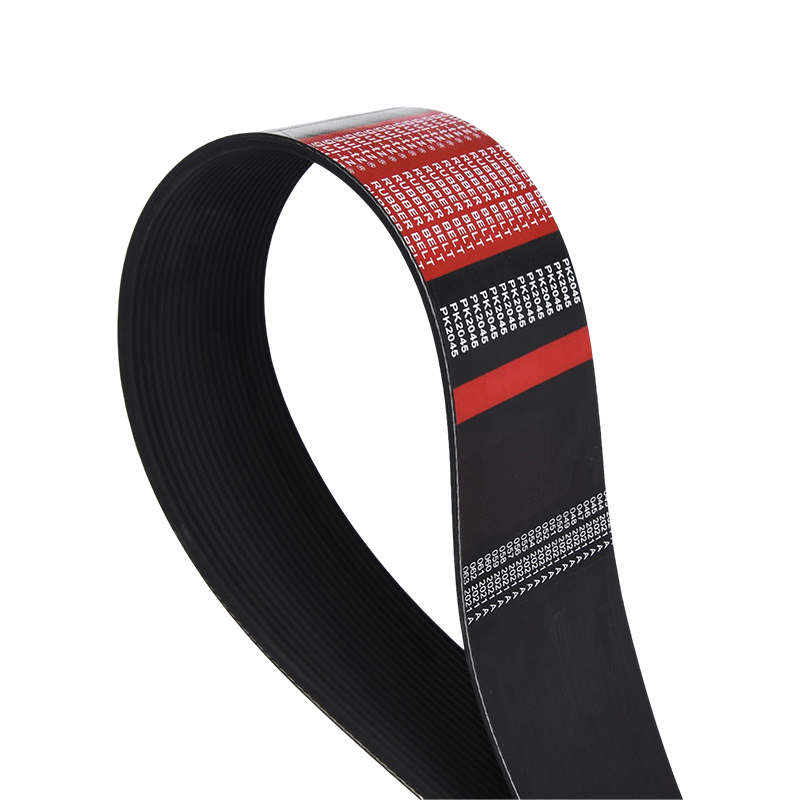 Ribbed Belt for Automotive and Industrial UseThis V-ribbed belt combines high transmission capacity with flexibility, enabling compact drives and small pulleys. It is suitable for high-speed, multi-axis layouts and offers good heat, oil, and wear resistance.View Product →
Because the load is shared among many ribs, a ribbed belt handles transient overloads better than a single V-belt of comparable width. Directional stability is also superior, leading to fewer tracking and edge-wear issues. The thin backing allows very small bending radii, which reduces the minimum centre distance for a given drive design.
Rubber Flat Belts
Rubber flat belts are the simplest belting form: a uniform strip of rubber compound with a fabric or steel tension member embedded near the centre of the cross-section. They transmit power by friction between the belt face and a cylindrical pulley. The wide contact surface and extremely low bending loss make them ideal for very high speed drives, long centre distances, and applications where vibration damping matters more than positioning precision. Typical examples are textile machines, edge banding equipment, woodworking machinery, and small conveyor heads.
For a flat belt to stay on a plain cylindrical pulley, one pulley face is usually crowned slightly. Correct tracking becomes essential on machines running at 20 m/s or faster. Rubber flat belts also require significantly higher initial tension than V-belts or timing belts, so take shaft loading into account when retrofitting.
Rubber Compounds and Construction Materials
Rubber compound choice affects traction, temperature range, chemical resistance, and wear life. The same belt construction can behave very differently when the compound changes. The table below lists the most relevant materials for transmission belts.
| Compound | Key Property | Typical Application |
|---|---|---|
| CR (chloroprene) | Balanced oil, weather, and heat resistance | General industrial timing belts and V-belts |
| NBR (nitrile) | Excellent oil and fuel resistance | Machinery exposed to hydraulic oil or solvent vapour |
| EPDM | Exceptional heat and ozone resistance | Automotive engine compartments and outdoor drives |
| HNBR | High tensile strength and heat resistance | Timing belts in modern diesel and high-performance engines |
| SBR | Good abrasion resistance at moderate cost | Economy industrial belts in clean, dry conditions |
Reinforcement is the second critical element. Synchronous belts rely on glass fibre or aramid cords to minimise elongation and keep the tooth pitch stable under load. V-belts and ribbed belts use polyester cords as the tension member, while heavy-duty flat belts may contain steel or aramid layers. The combination of rubber compound and tension member determines how much power the belt can carry and how stable its length remains during its working life.
How to Choose the Right Rubber Belt
There is no single best belt for every machine. The correct selection comes from looking at the drive conditions in a fixed order.
- Calculate power and speed. Determine drive power in kilowatts and the expected speed range. High torque at low speed favours wide V-belts or synchronous belts. Very high speed with low torque favours ribbed or flat belts.
- Measure shaft geometry. Record the centre distance between shafts and the available pulley diameters. Tight centres and small pulleys call for flexible belts, such as cogged V-belts, ribbed belts, or fine-pitch synchronous belts.
- Define the accuracy requirement. If the driven shaft must stay in time with the drive shaft, a synchronous belt is required. For simple speed transmission, any of the friction-based families can work.
- Check the operating environment. Consider temperature, oil mist, ozone, humidity, and abrasive dust. High ambient temperature points toward EPDM or HNBR. Exposure to cutting fluids suggests NBR. Outdoor drives with direct sun require ozone-resistant compounds.
Relative Speed Capability
Relative Load Capacity
The values above are directional guidance, not exact rating data. Actual performance depends on belt width, profile size, rubber compound, and pulley design.
Frequently Asked Questions
What is the difference between a timing belt and a V-belt?
A timing belt has teeth that mesh with grooved pulleys, so it cannot slip. A V-belt relies on the wedging action of its trapezoidal cross-section and always has a small amount of slip. Timing belts are mandatory when shaft positions must stay locked. V-belts are preferred when cost, shock absorption, and ease of installation matter more.
How long should a rubber V-belt last?
A correctly aligned and properly tensioned wrapped V-belt in a clean, cool environment can run several thousand hours. Raw-edge cogged belts and ribbed belts often last longer because they generate less internal heat. The most common causes of early failure are misalignment, incorrect tension, and oversised sheaves with incorrect groove geometry.
Can a ribbed belt replace a V-belt on an existing drive?
Not without changing the pulley. A ribbed belt requires a grooved pulley with the same rib spacing and profile. Ribbed belts are a good option for new drive designs where space is limited, but they are not a drop-in replacement for a classical single V-belt on the same sheave.
What causes synchronous belts to fail early?
The most frequent failure mechanisms are tooth shear under overload, fatigue of the tension cords, worn or corroded sprockets, and contamination by particles that embed in the rubber. High ambient temperature and poor alignment accelerate every one of these mechanisms.
How do I identify a rubber belt from its markings?
Most industrial belts carry a code that indicates section, length, and construction. For example, an industrial V-belt marked SPZ 1000 means a narrow wedge section with a reference length of 1000 millimetres. A synchronous belt is identified by its pitch and number of teeth, such as T10 900. Keep the old belt or its printed code when ordering a replacement, and match the width and profile exactly.
What to Check Before Buying Belts in Volume
Once the belt family and profile are selected, buying quality becomes the next concern. Key manufacturing factors are compound consistency, tension cord material, vulcanisation control, and dimensional tolerance. A belt that looks identical in the catalogue can have a very different service life if its tooth pitch is inaccurate, or if the rubber formulation changes from one batch to another. As a manufacturer, Ningbo GUL TZ Rubber Belt Co., Ltd. has produced synchronous belts, V-belts, ribbed belts, flat belts, and matching pulleys since 1992. The factory is certified to ISO 9001, ISO 14001, and ISO 45001, and has participated in drafting national and industry belt standards. If you are specifying belts for a machine-building or plant operation project, it is worth reviewing our company profile and production history before requesting a quotation.
The last point is the most practical one: service life depends more on correct selection and proper installation than on the belt itself. Measure the drive conditions honestly, choose the right family, align the pulleys, and tension the belt to the manufacturer's recommended value. A rubber belt will then run for thousands of hours without attention. Choose the wrong family, and no belt will last.
You can learn more about our company background and quality systems on the about us page.
Hot Products
-
 View More
-
 View More
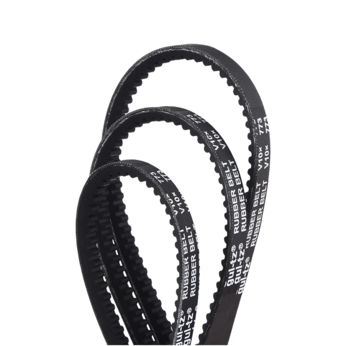
V-belt For Industry
-
 View More
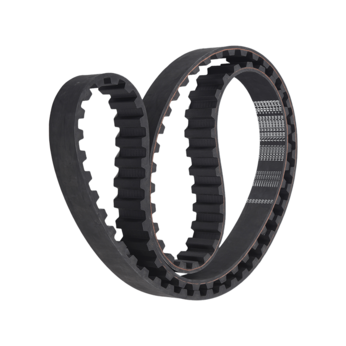
T Type Industry Rubber Synchronous Belt
-
 View More
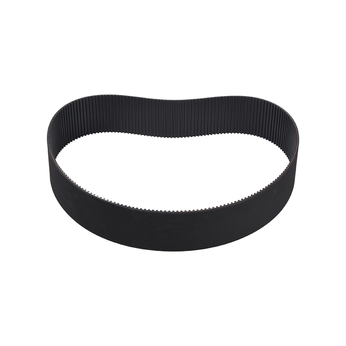
Toothed wedge belt
-
 View More
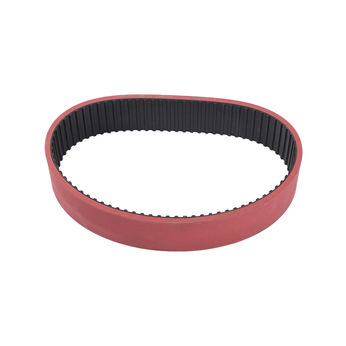
Thickened timing belt
-
 View More
Open Timing Belt
-
 View More
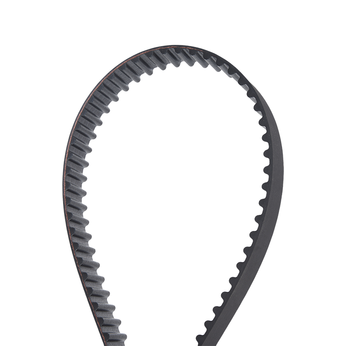
Automotive V-belt
-
 View More
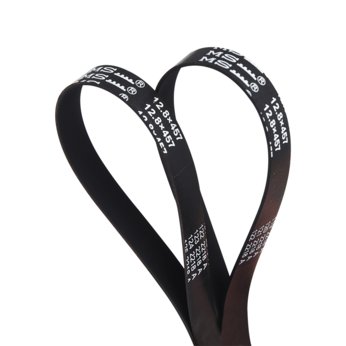
Rubber Flat Belt
-
 View More
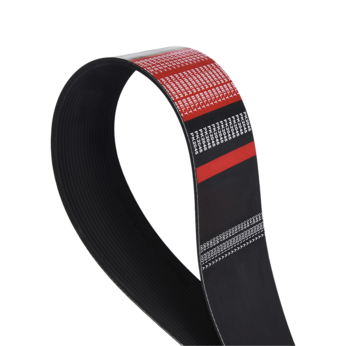
Ribbed Belt
-
 View More
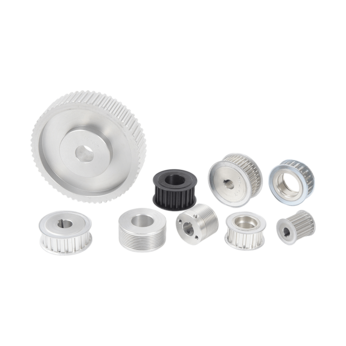
Synchronous Pulley
-
 View More
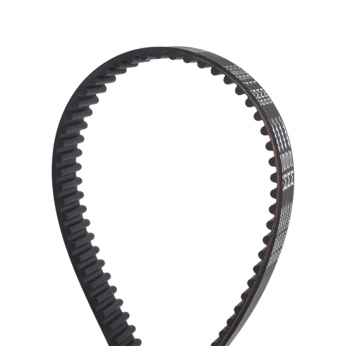
Arc tooth industrial rubber synchronous belt
-
View More
Automotive timing belt

Do you have a question? Feel free to contact!
 Tel: +86-0574-62498188 62497298
 Fax: +86-0574-62497297
 E-mail:
  Add: No. 65, Middle Jinniu Road, Moushan Town, Yuyao City, Zhejiang Province, China
Copyright © Ningbo GUL TZ Rubber Belt Co., Ltd. All rights reserved.

OEM Rubber Driving belts Manufacturers
